

Introduction
Food delivery apps like Swiggy and Zomato are popular real-world applications. Building such an app involves multiple components working together.
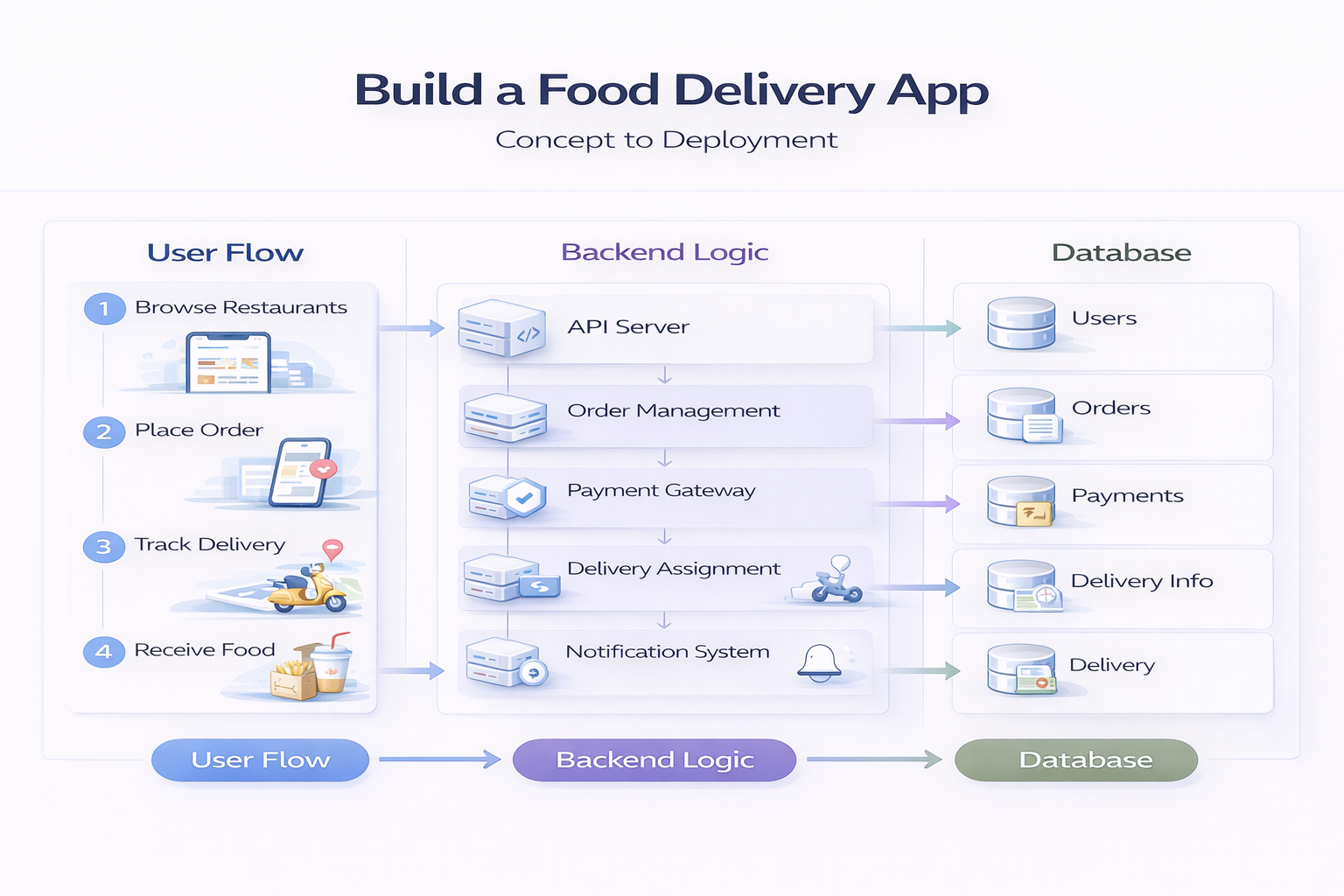
In this guide, you will understand how to build a food delivery app from concept to deployment.
Overview of Food Delivery App
A food delivery app consists of:
- Frontend (User Interface)
- Backend (Server Logic)
- Database (Data Storage)
- Payment & Delivery system
User Flow (How Users Interact)
- User opens app
- Searches for restaurants
- Selects food items
- Adds items to cart
- Places order
- Makes payment
- Receives order updates
Frontend (User Interface)
The frontend handles user interaction.
Features:
- Restaurant listing
- Menu display
- Cart system
- Order tracking
Technologies:
- HTML, CSS, JavaScript
- React or Flutter (for apps)
Backend Logic
Backend processes user requests and handles business logic.
Responsibilities:
- User authentication
- Order management
- Payment processing
- Notification system
Technologies:
- Node.js
- Express.js
Database (Data Storage)
The database stores all app data.
Stores:
- User details
- Restaurant data
- Orders
- Payments
Technologies:
- MongoDB or MySQL
Payment Integration
Users can pay online using payment gateways.
Flow:
- User enters payment details
- Payment gateway processes transaction
- Backend confirms order
Order & Delivery System
- Order is sent to restaurant
- Delivery partner is assigned
- User tracks order in real time
Complete Workflow
- User places order
- Backend validates request
- Order saved in database
- Payment processed
- Restaurant receives order
- Delivery partner picks order
- User receives delivery
Deployment
After development:
- App is deployed on servers
- Backend hosted on cloud
- Database connected
Real Project Tech Stack (Example)
- Frontend: React / Flutter
- Backend: Node.js
- Database: MongoDB
- Cloud: AWS
Key Learning Points
- Full stack integration is important
- Real-time updates improve user experience
- Scalable backend is required
Conclusion
Building a food delivery app helps you understand real-world software development. It includes frontend, backend, database, and deployment.
Start learning with Mango Engineers and build real-world projects.