

Introduction
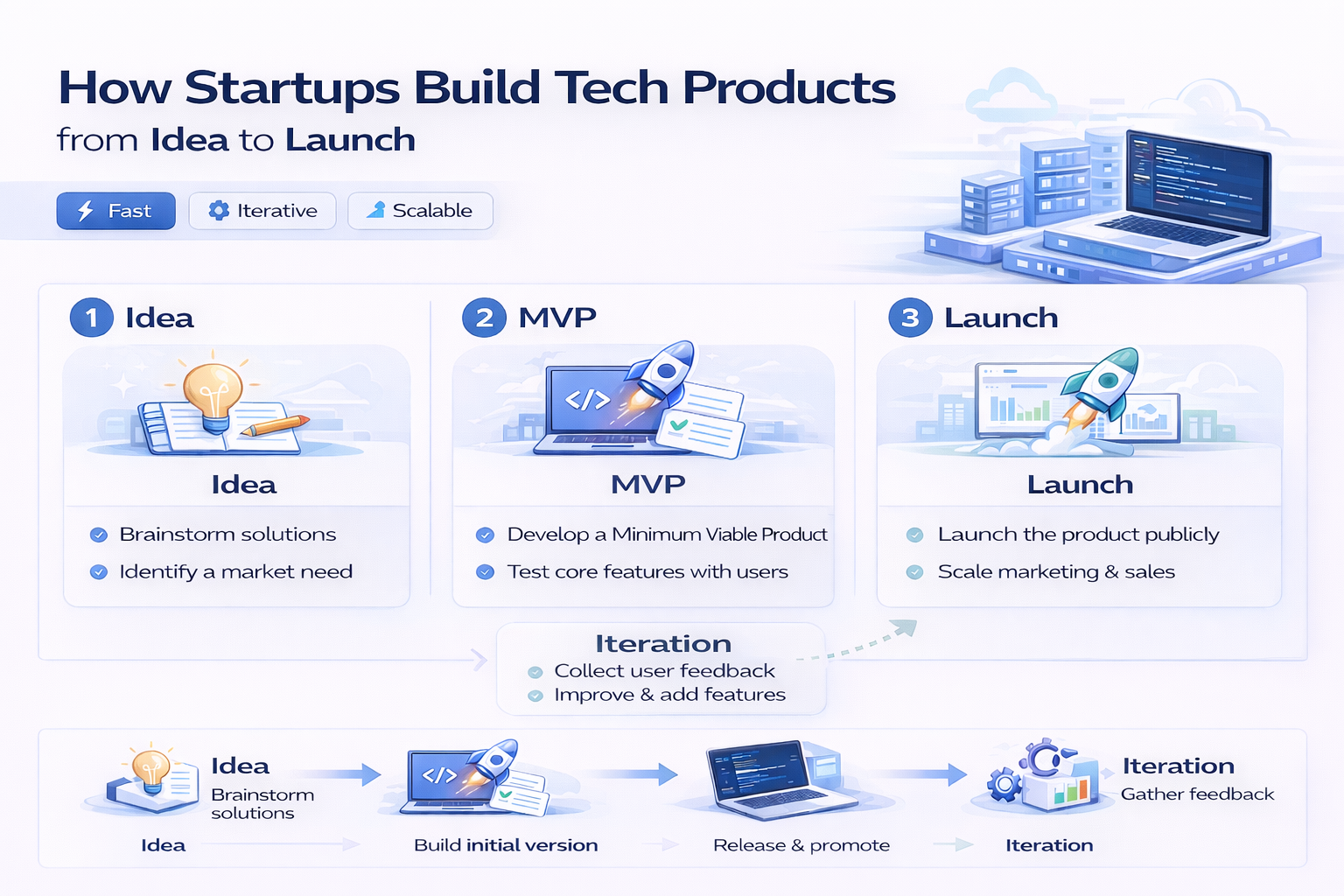
Startups are known for building innovative tech products quickly and efficiently. But how do they go from just an idea to a fully launched product?
In this guide, you will understand the complete journey from idea to MVP to launch and iteration.
Startup Product Development Overview
Startups follow a lean and fast process:
- Idea validation
- MVP development
- Product launch
- Continuous improvement
Step 1: Idea (Problem Identification)
Every startup begins with an idea, usually solving a real problem.
Key Activities:
- Identify a problem
- Research market demand
- Analyze competitors
Example:
Food delivery apps solve the problem of ordering food easily.
Step 2: Validate the Idea
Before building, startups validate whether people actually need the product.
Methods:
- Surveys
- Landing pages
- User feedback
Step 3: Build MVP (Minimum Viable Product)
MVP is a basic version of the product with core features.
Purpose:
- Test idea quickly
- Save time and cost
- Get user feedback
Example:
An MVP food app may only include:
- Restaurant listing
- Order placement
Step 4: Product Development
After MVP validation, startups build the full product.
Includes:
- Frontend development
- Backend development
- Database integration
Approach:
- Agile development
- Iterative releases
Step 5: Launch Product
The product is released to users.
Activities:
- Deployment
- Marketing
- User onboarding
Step 6: Iteration (Continuous Improvement)
Startups continuously improve based on user feedback.
Includes:
- Adding new features
- Fixing bugs
- Improving performance
Key Concept:
Build → Measure → Learn
Real Startup Workflow Example
- Idea is generated
- Market research is done
- MVP is built
- Users test product
- Feedback is collected
- Product is improved and scaled
Tools Used by Startups
- Design: Figma
- Development: React, Node.js
- Project Management: Trello, Jira
- Deployment: AWS, Vercel
Tips for Beginners
- Focus on solving real problems
- Start small (MVP first)
- Learn from feedback
- Improve continuously
Conclusion
Startups succeed by building fast, testing ideas, and improving continuously. Understanding this process helps you build real-world products.
Start learning with Mango Engineers and create your own tech products.