

Have you ever wondered what happens when you type a website URL and press enter? Within seconds, a complete webpage appears on your screen. But behind the scenes, a lot is happening.
Let’s understand how websites actually work in a simple and beginner-friendly way.
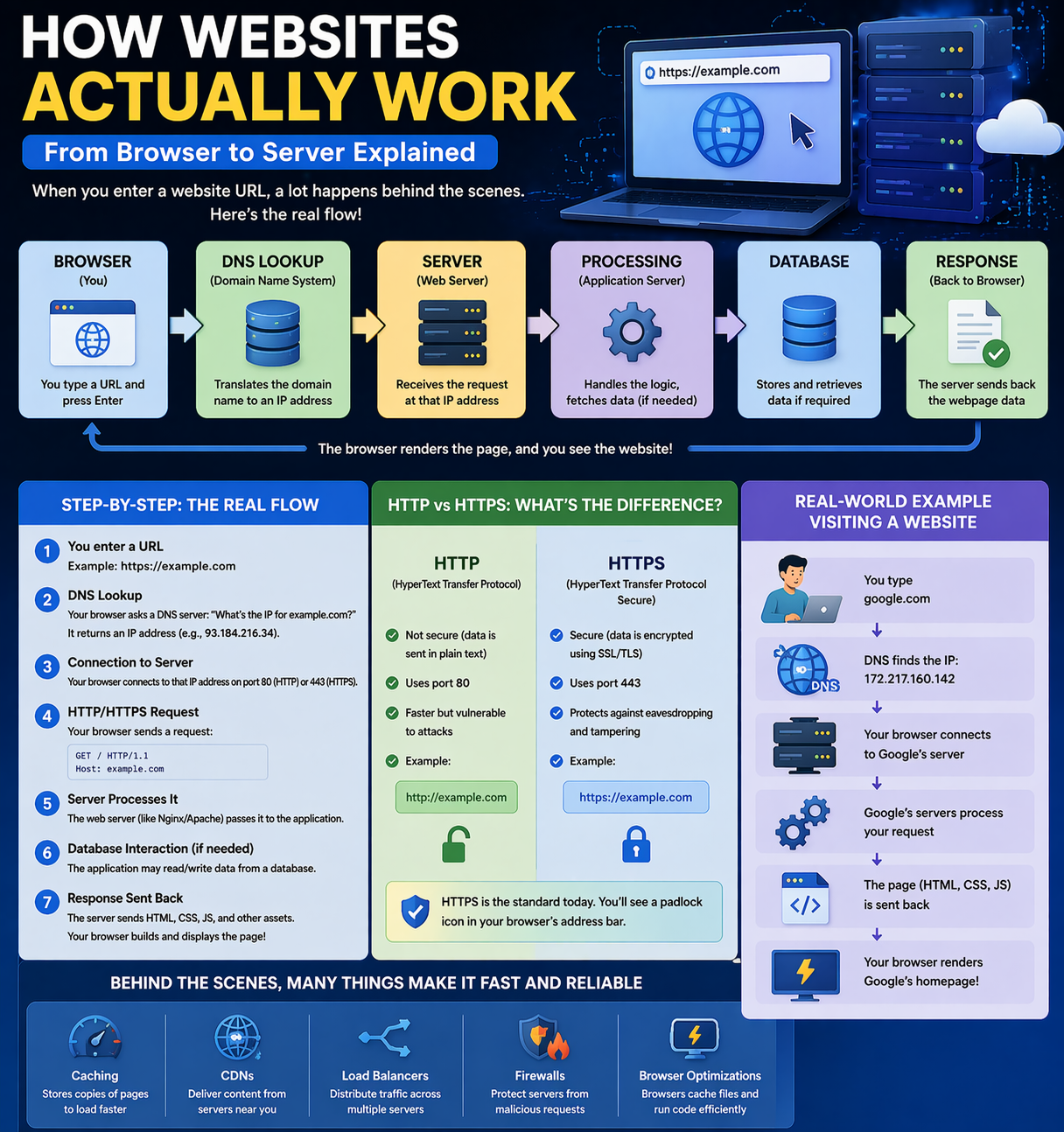
1. Step-by-Step Flow (DNS → Server → Response)
Step 1: Enter URL in Browser
You type a website URL (like google.com) in your browser.
Step 2: DNS Lookup
DNS (Domain Name System) converts the website name into an IP address.
👉 Example: google.com → 142.250.xxx.xxx
Step 3: Request Sent to Server
Your browser sends a request to the server where the website is hosted.
Step 4: Server Processing
The server processes the request and prepares the required data.
Step 5: Response Sent Back
The server sends a response (HTML, CSS, JavaScript) back to your browser.
Step 6: Browser Displays Website
Your browser renders the content and displays the webpage.
2. HTTP vs HTTPS
HTTP and HTTPS are protocols used for communication between browser and server.
HTTP (HyperText Transfer Protocol):
- Transfers data between client and server
- Not secure
HTTPS (Secure HTTP):
- Encrypted communication
- Protects user data
- Used in secure websites (banking, login systems)
👉 Always prefer HTTPS websites for safety
3. Real-World Example (How It Works)
Let’s take an example of opening an e-commerce website:
- You enter the website URL
- DNS finds the server IP
- Browser sends request
- Server fetches product data from database
- Server sends response (HTML, CSS, JS)
- Website loads with products on your screen
Why Understanding This is Important?
- Helps in learning web development
- Improves debugging skills
- Gives clarity on frontend & backend connection
Beginner Recommendation
If you are starting:
- Learn basics of how the web works
- Understand HTTP/HTTPS
- Explore frontend and backend roles
- Build small web projects
Final Thoughts
Understanding how websites work gives you a strong foundation in web development. It helps you connect the dots between browser, server, and data flow.
At Mango Engineers, we focus on practical learning, real-world projects, and mentorship to help students become industry-ready developers.
Call to Action
Start learning web development with Mango Engineers and build real-world websites today!