

Introduction
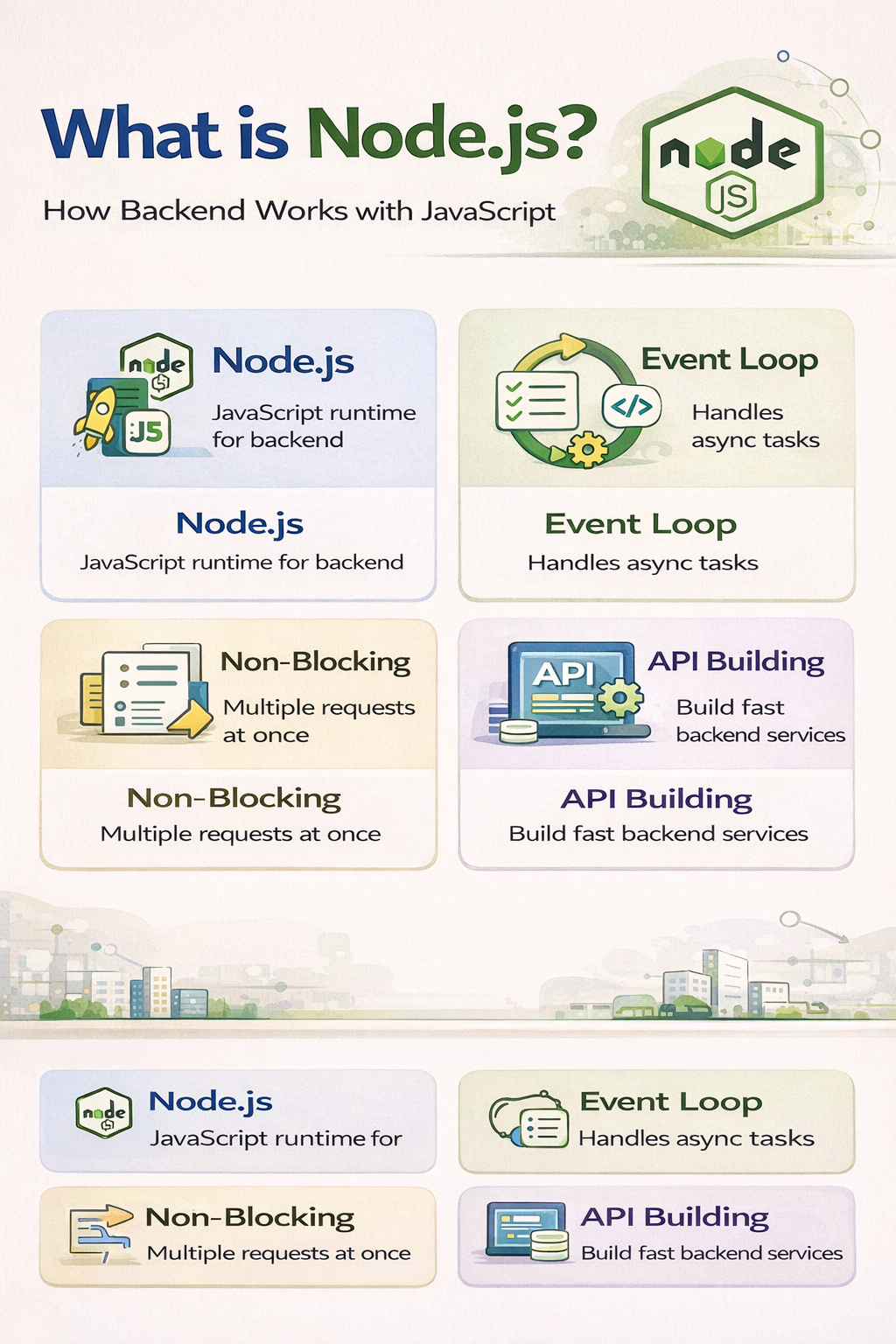
Node.js is a powerful runtime environment that allows developers to run JavaScript on the server side. Traditionally, JavaScript was used only for frontend development, but Node.js changed the game by enabling backend development using JavaScript.
Today, Node.js is widely used for building fast, scalable, and real-time applications.
What is Node.js?
Node.js is a JavaScript runtime built on Chrome’s V8 engine. It allows developers to execute JavaScript code outside the browser.
This means you can use JavaScript to build backend servers, APIs, and full-stack applications.
How Backend Works with JavaScript
In a web application:
- Frontend (client) sends a request
- Backend (server) processes the request
- Server sends a response
Node.js acts as the backend server that handles these requests and responses.
Example:
- User clicks “Login”
- Request goes to Node.js server
- Server checks database
- Sends response back to frontend
Understanding the Event Loop
The event loop is the core of Node.js.
It allows Node.js to handle multiple requests at the same time without blocking execution.
Instead of waiting for one task to finish, Node.js continues executing other tasks.
This makes it highly efficient and fast.
What is Non-Blocking I/O?
Node.js uses non-blocking (asynchronous) operations.
This means:
- It does not wait for tasks like database queries or file reading
- It continues executing other code
- Once the task is complete, it returns the result
Example:
- Reading a file
- Calling an API
- Fetching database data
This improves performance and scalability.
Event Loop vs Traditional Backend
| Feature | Node.js | Traditional Backend |
|---|---|---|
| Execution | Non-blocking | Blocking |
| Performance | High | Moderate |
| Scalability | High | Lower |
Building APIs with Node.js
APIs (Application Programming Interfaces) allow frontend and backend to communicate.
Using Node.js, developers can create REST APIs easily.
Example using Express.js:
const express = require('express');
const app = express();

app.get('/', (req, res) => {
  res.send('Hello from Mango Engineers Backend!');
});

app.listen(3000, () => {
  console.log('Server running on port 3000');
});
Why Companies Use Node.js
1. Fast Performance
Node.js uses V8 engine for fast execution.
2. Single Language (JavaScript)
Developers can use JavaScript for both frontend and backend.
3. Scalable Applications
Handles multiple users efficiently.
4. Real-Time Applications
Used in chat apps, streaming apps, and live dashboards.
Real Use Cases of Node.js
1. Chat Applications
Real-time messaging apps like chat systems.
2. Streaming Platforms
Video and music streaming services.
3. E-commerce Websites
Handling multiple users and transactions.
4. APIs for Mobile Apps
Backend services for Android and iOS apps.
Advantages of Learning Node.js
- High demand in industry
- Easy for JavaScript developers
- Large ecosystem (NPM)
- Great for startups and scalable apps
Conclusion
Node.js is a powerful backend technology that allows developers to use JavaScript beyond the browser. With features like event loop and non-blocking I/O, it provides high performance and scalability.
If you want to become a full-stack developer, learning Node.js is essential.
Start learning with Mango Engineers and build real-world backend applications.