

If you are learning programming or web development, you will often hear the term API. APIs are a crucial part of modern applications and help different systems communicate with each other.
Let’s understand APIs in a simple and beginner-friendly way.
1. What is an API?
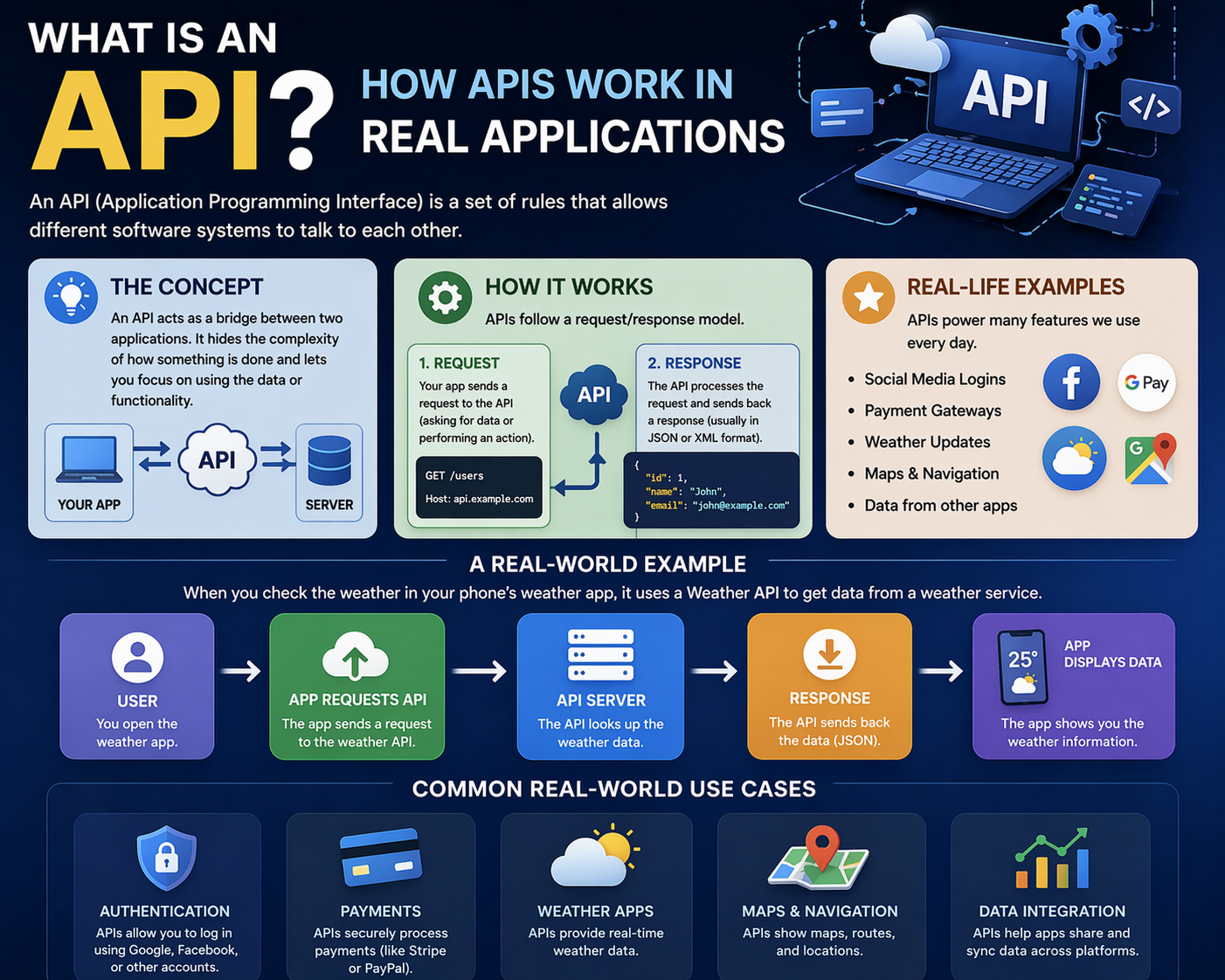
API stands for Application Programming Interface. It acts as a bridge between different software systems.
What API Does:
- Allows applications to communicate
- Sends and receives data
- Connects frontend with backend services
👉 Example: When you use a weather app, it fetches data from a server using an API
👉 Think of API as a messenger that takes your request and returns a response
2. Request and Response (How API Works)
APIs work on a request and response cycle.
Step-by-Step Flow:
- Client (Frontend) sends a request
- API processes the request
- Server sends a response
- Client displays the data
Types of Requests:
- GET → Fetch data
- POST → Send data
- PUT → Update data
- DELETE → Remove data
👉 Example: Login system sends username & password → API verifies → response is success or error
3. Real-Life Examples of APIs
Common API Use Cases:
- Payment gateways (UPI, Stripe, Razorpay)
- Google Maps integration
- Login with Google/Facebook
- Weather apps
👉 Example: When you order food online, the app uses APIs to fetch restaurant data, process payments, and track delivery
Why APIs are Important?
- Enable communication between systems
- Save development time
- Allow integration with third-party services
- Essential for modern web and mobile apps
Beginner Recommendation
If you are new:
- Understand API basics
- Learn how to use APIs with JavaScript (fetch/axios)
- Practice using public APIs
- Build small projects
Final Thoughts
APIs are the backbone of modern applications. Understanding how APIs work will help you build powerful and scalable applications.
At Mango Engineers, we focus on practical learning, real-world projects, and mentorship to help students become industry-ready developers.
Call to Action
Start learning APIs with Mango Engineers and build real-world applications today!