


Introduction
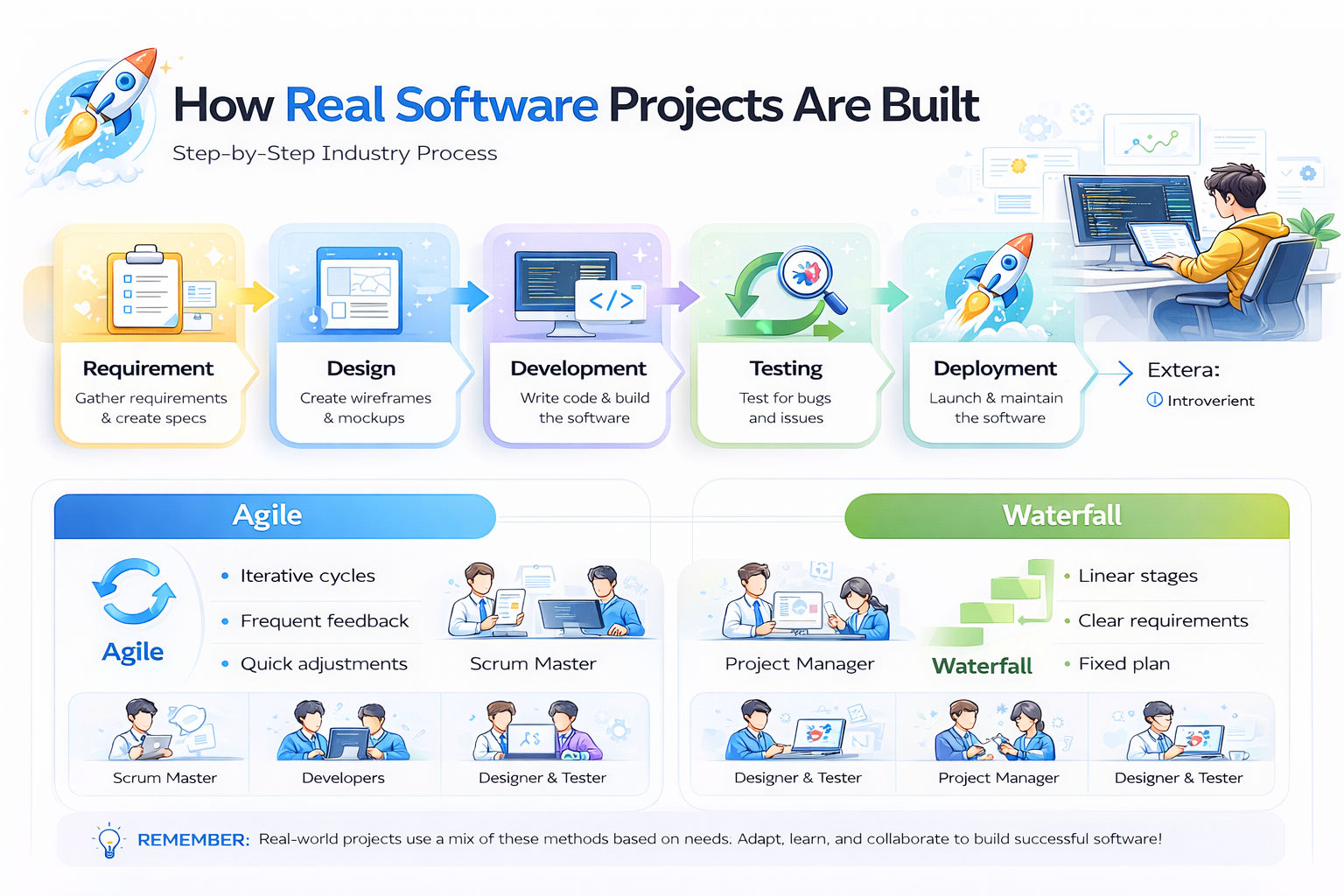
Have you ever wondered how real software projects are built in companies? From idea to deployment, software development follows a structured process to ensure quality and efficiency.
In this guide, you will learn the complete step-by-step industry process.
Software Development Lifecycle (SDLC)
The process of building software is called SDLC (Software Development Life Cycle).
It includes multiple stages from planning to deployment.
Step-by-Step Process of Building Software
1. Requirement Gathering
This is the first step where client requirements are collected.
Key Activities:
- Understanding client needs
- Defining project scope
- Creating documentation
2. Design Phase
In this phase, the system architecture and UI/UX design are created.
Key Activities:
- Wireframing
- Database design
- System architecture planning
3. Development Phase
Developers start writing code based on the design.
Key Activities:
- Frontend development
- Backend development
- API creation
4. Testing Phase
Testing ensures the software works correctly.
Key Activities:
- Manual testing
- Automation testing
- Bug fixing
5. Deployment Phase
The application is launched for users.
Key Activities:
- Hosting
- Server setup
- Monitoring
6. Maintenance & Updates
After deployment, updates and improvements are made.
Agile vs Waterfall Model
Waterfall Model:
- Linear approach
- Each phase completed before next
- Less flexibility
Agile Model:
- Iterative approach
- Continuous development and feedback
- More flexible and widely used
Team Roles in Software Projects
1. Project Manager
- Manages project timeline and team
2. Business Analyst
- Understands requirements
3. UI/UX Designer
- Designs user interface
4. Developers
- Build frontend and backend
5. QA/Testers
- Test the application
6. DevOps Engineer
- Handles deployment and infrastructure
Real-World Workflow Example
- Client gives requirement
- Team plans and designs system
- Developers build features
- Testers find and fix bugs
- Product is deployed
- Continuous updates are made
Tips for Beginners
- Understand SDLC clearly
- Learn teamwork and collaboration
- Work on real projects
- Learn version control (Git)
Conclusion
Real software projects follow a structured process involving multiple roles and stages. Understanding this workflow helps you become industry-ready.
Start learning with Mango Engineers and build real-world software projects.