

Introduction
Data structures are a fundamental part of programming. They help in organizing and storing data efficiently so that it can be accessed and modified easily.
Understanding data structures is essential for writing efficient programs and solving complex problems.
What is a Data Structure?
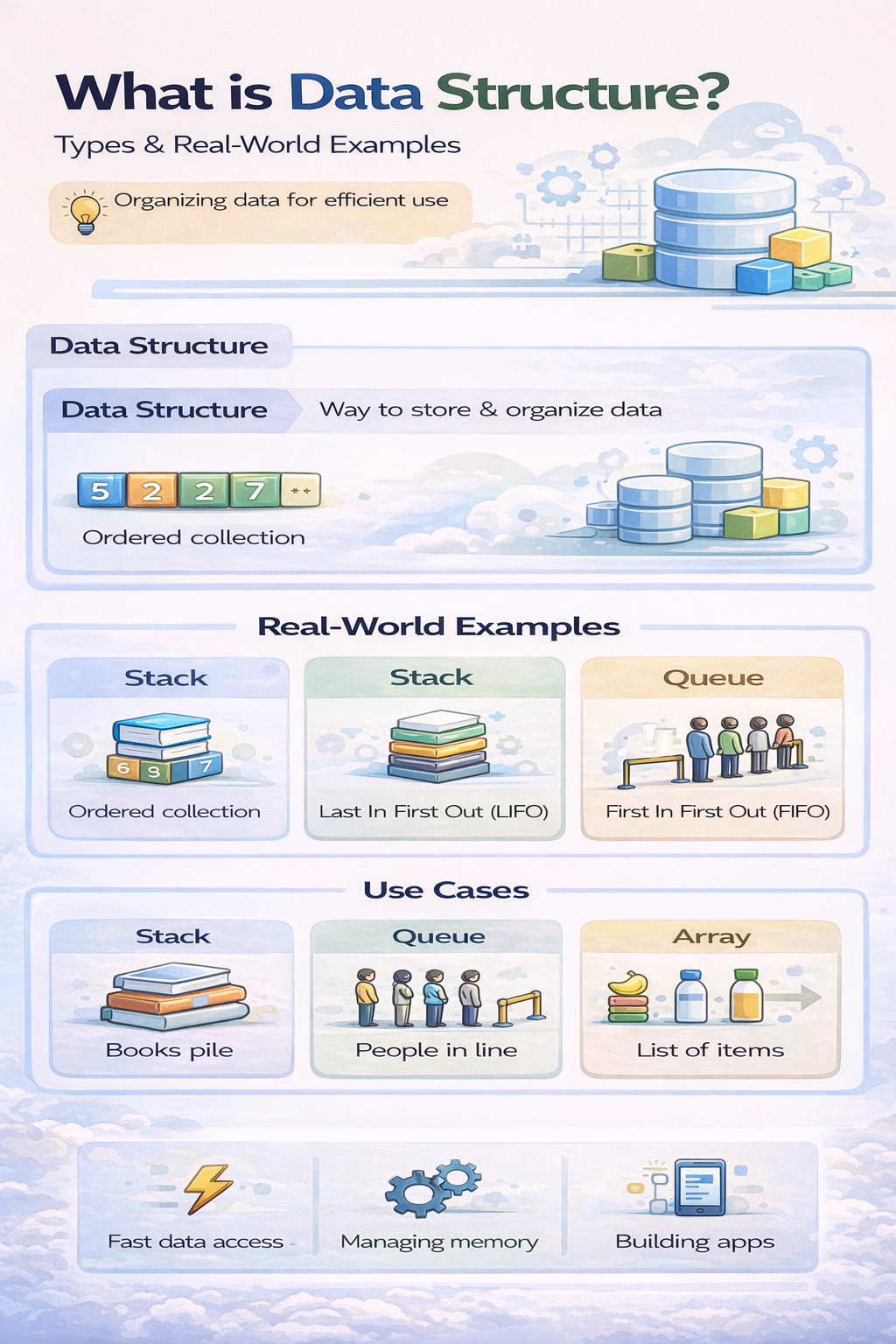
A data structure is a way of organizing and storing data in a computer so that it can be used effectively.
It defines how data is arranged, accessed, and manipulated.
Why Data Structures are Important
- Improves performance of programs
- Helps manage large amounts of data
- Makes code efficient and optimized
- Essential for problem solving and interviews
Types of Data Structures
1. Arrays
An array is a collection of elements stored at contiguous memory locations.
Example:
let arr = [10, 20, 30, 40];
Use Cases:
- Storing lists of data
- Accessing elements quickly using index
2. Stack (LIFO)
Stack follows Last In, First Out principle.
Example:
- Plates in a stack
Operations:
- Push (add element)
- Pop (remove element)
Use Cases:
- Undo/Redo functionality
- Browser history
3. Queue (FIFO)
Queue follows First In, First Out principle.
Example:
- Line at a ticket counter
Operations:
- Enqueue (add element)
- Dequeue (remove element)
Use Cases:
- Task scheduling
- Print queue
Real-World Examples
1. Social Media Feed
Uses arrays/lists to store posts.
2. Call Center System
Uses queue to manage customer calls.
3. Undo Feature in Apps
Uses stack to reverse actions.
Advantages of Learning Data Structures
- Improves coding skills
- Helps in cracking interviews
- Makes you a better problem solver
Conclusion
Data structures are the backbone of programming. By understanding arrays, stacks, and queues, you can build efficient and scalable applications.
Start learning data structures with Mango Engineers and strengthen your programming foundation.