

Practical technology learning
Node.js: Explain Why Await Does Not Move CPU Work Off the Event Loop
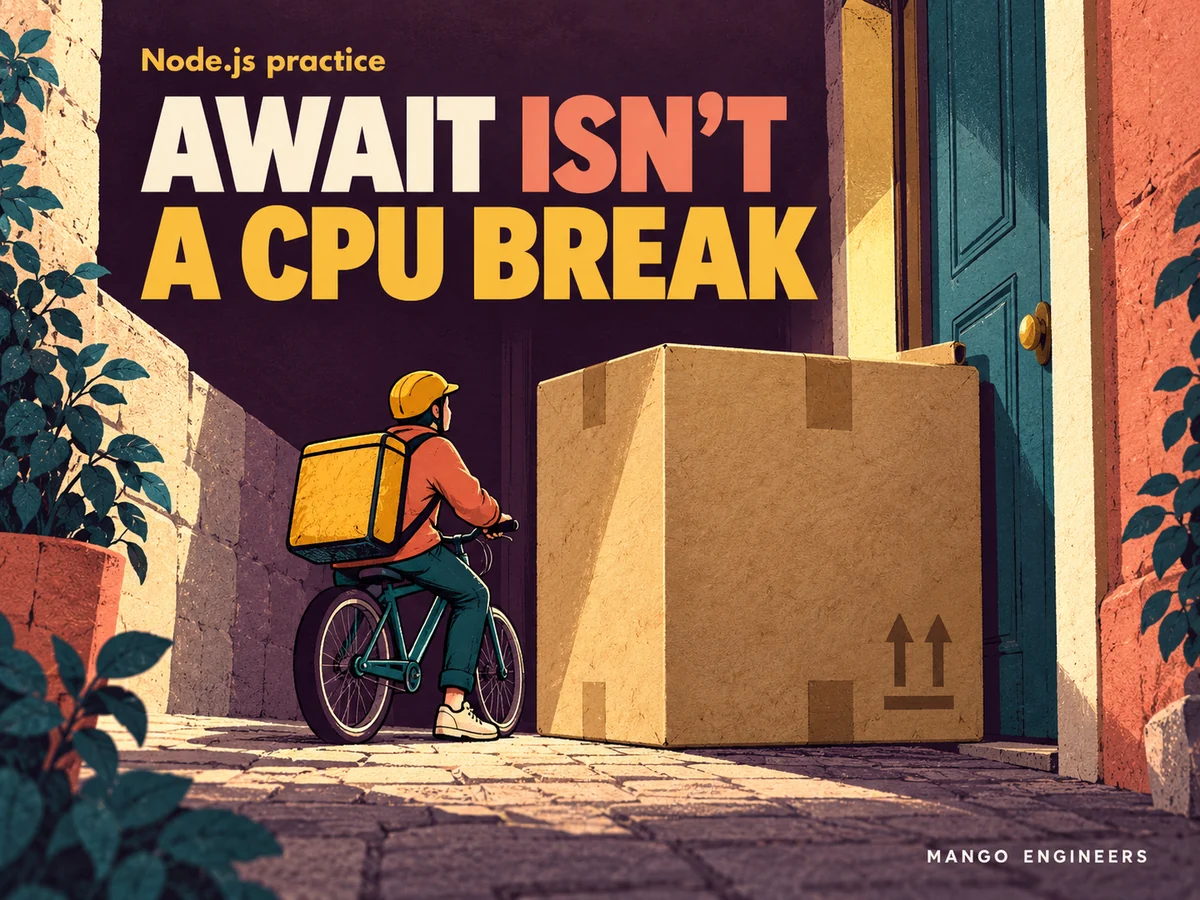
An async function can still hold up other JavaScript work. The keyword describes how a function returns and can suspend; it does not automatically move a long calculation onto another thread.
Separate two questions
Ask whether the program is waiting for an external operation or actively using the JavaScript thread to calculate a result. Non-blocking I/O can let other callbacks run while an operation is pending. A large synchronous calculation still occupies the event-loop thread while that calculation executes.
This distinction supports Node.js backend learning in Jaipur without requiring a deployed server or a load-testing service. Use an isolated local script and a deliberately small workload.
Design a bounded observation
Schedule a timer that logs a short message. Immediately run a finite calculation with a conservative iteration limit, then log that the calculation has finished. Predict the message order. The timer callback cannot interrupt the currently running synchronous JavaScript merely because its delay has elapsed.
Record the environment and the iteration limit. Increase work only within a comfortable local bound, and stop if the script becomes unresponsive. Do not run a stress experiment on a shared application or public endpoint.
Test the async misconception
Wrap that same finite synchronous calculation in an async function and call it. Work before the first suspension still executes synchronously. If the calculation is passed as an argument to Promise.resolve, it must be evaluated before Promise.resolve receives the result. Adding await around that result does not relocate the calculation.
Distinguish yielding from parallel execution
Breaking suitable work into bounded chunks can allow other event-loop tasks to run between chunks. Worker threads are a separate option for appropriate CPU-intensive JavaScript. Both approaches require a design decision about errors, data transfer, cancellation and resource limits; neither should be introduced as a magic speed switch.
A useful next step is to label each operation in a small endpoint as input validation, I/O wait, synchronous processing or response construction. That inventory reveals where measurement is needed.
Keep claims proportional to the experiment
- Compare callback order rather than promising an exact timer delay.
- Do not infer production capacity or response-time guarantees from one laptop run.
- Retain the source script and the observed output together so the explanation can be checked.
Write a short conclusion
Explain which section kept the JavaScript thread busy and which operation actually waited asynchronously. The Mango Engineers Node.js course is the related learning path for runtime and backend foundations; confirm its current prerequisites and coverage rather than assuming this lab is a scheduled class.